Calorintel estimates your calorie deficit or surplus from your weight trend alone — no food logging, no guesswork.
You never log food. The calorie number is an output — derived from your weight, not something you enter.
See how you can
manage your weight
without logging food.
Watch 3 months of real weight data build day by day — trend, deficit, and coaching signal, all from one daily number.
A real weight loss journey replayed as it appears in Calorintel — rolling average, energy balance, goal tracking, and contextual events, all building in real time.
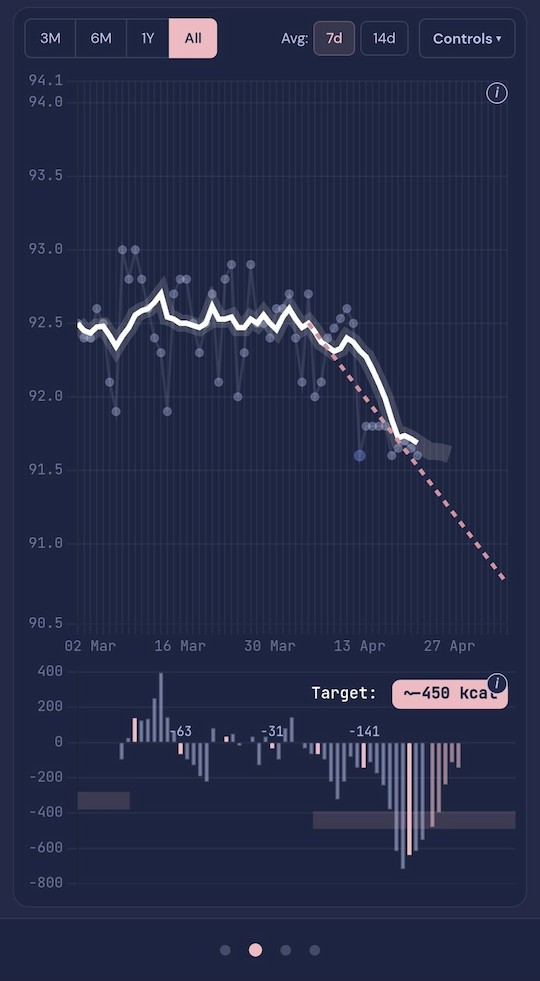
Daily readings bounce around. The white line is your rolling average — that's the number that actually matters.
Watch the signal below the chart react as the trend shifts. A plain-language answer telling you what to do.
The bar chart shows your estimated daily deficit or surplus — calculated automatically. No meal logging needed.
A real weight loss journey replayed as it appears in Calorintel.
Daily readings bounce around. The white line is your rolling average — that's the number that actually matters.
Watch the signal below the chart react as the trend shifts. A plain-language answer telling you what to do.
The bar chart shows your estimated daily deficit or surplus — calculated automatically. No meal logging needed.
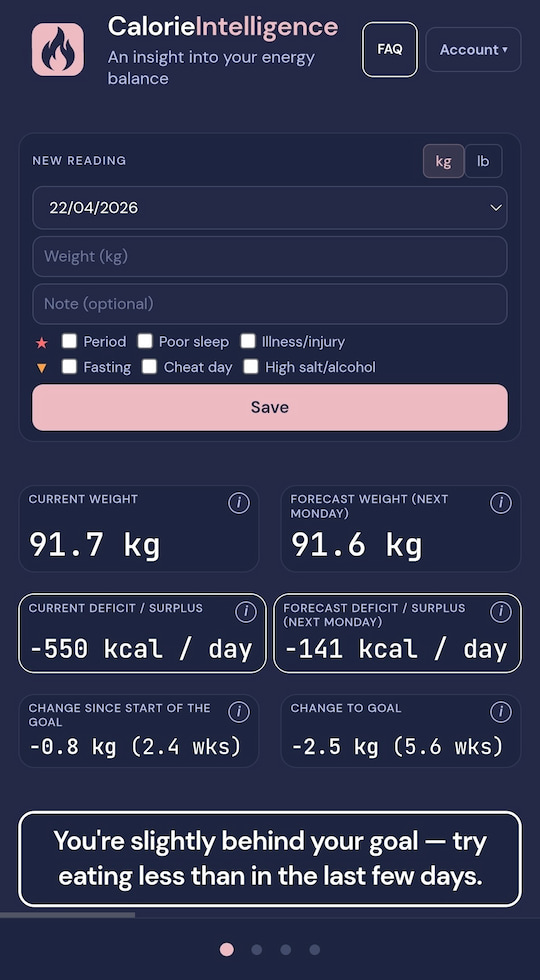
Enter your weight, add optional context, and get one clear answer: are you on track? The signal box tells you what to do next — no food logging, no calorie math.
Two charts, one picture. Your weight trend stripped of daily noise, and your estimated calorie balance week by week. See what your body is actually doing — not what your food diary says it should be.
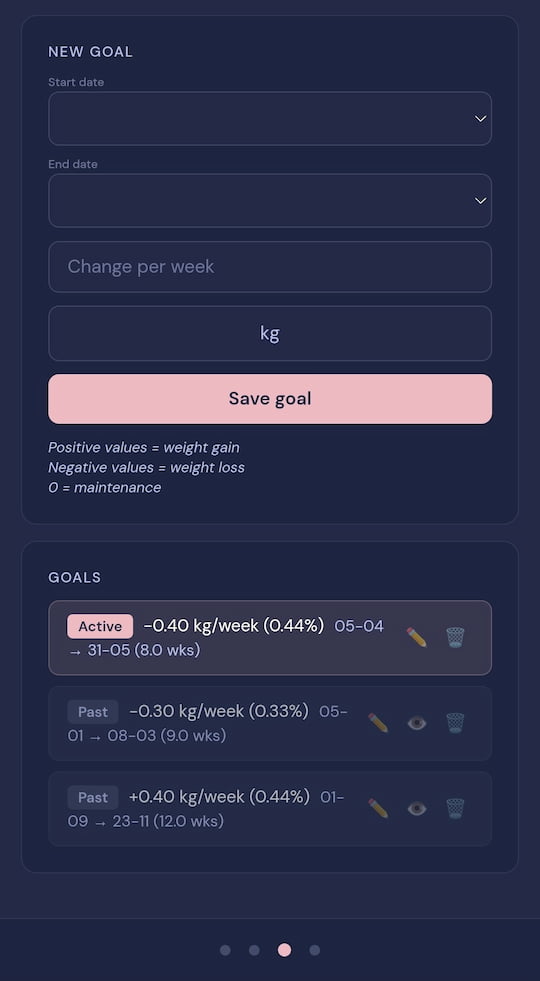
Set a goal, track your pace, review your history. Calorintel tells you whether your weight trend is following your plan — and flags when your rate of change is moving too fast or too slow.
Step on the scale, enter your weight, and you're done. Add an optional note or tag an event — poor sleep, high sodium, fasting — so you can explain anomalies later, not stress about them now.
Calorintel estimates your calorie deficit or surplus from your weight trend alone. No food logging, no guessing. See whether your current pace puts you ahead, on track, or drifting — before next Monday arrives.
The signal box cuts through the noise. One plain-English verdict based on your rolling average versus your goal: keep going, or nudge your intake. Thirty seconds of input. One actionable answer.
Your daily readings become a smooth trend line — raw fluctuations faded into the background, the real direction front and center. No more second-guessing a single number that moved the wrong way.
The weight chart shows your rolling average, your goal trajectory, and where the two diverge. You see instantly whether your body is following the plan — or whether something has quietly gone off course.
Below the weight chart, a calorie balance chart shows your estimated daily deficit or surplus week by week. Watch your energy balance respond to your choices — without logging a single meal.
Define a goal by start date, end date, and weekly rate of change. Whether you're cutting fat, building muscle, or holding steady — Calorintel draws your target line and tracks whether your trend follows it.
Set your rate of change per week. The app validates your pace against safe thresholds and tells you if you're pushing too hard — protecting you from goals that look ambitious on paper but cost muscle in practice.
Every completed goal stays in your history. Over months and years you build a record of what rates worked, what phases looked like, and how far you've come — the kind of context no food diary ever gave you.
Six articles covering the science, the limits, and the practice behind weight-trend tracking.
Your weight can swing by 2 kg (4 lbs) in a day without gaining an ounce of fat. Here's what's actually happening.
Food labels, portions, and app databases all carry errors that compound. The numbers you log may be off by hundreds of calories.
Calorie apps track what you eat. They ignore or miscalculate what you burn — and that side shifts by hundreds of calories daily.
Your rolling average contains your real energy balance. Here's the math, the evidence, and when to trust it.
Your weight stalled but your body didn't. Most plateaus are water hiding fat loss — here's the physiology and why they end.
The 30-second daily routine, what every number on your dashboard means, and how to get the most out of your data.
How to Eat When You're Not Counting Calories
I always struggled with weight, no matter what. When I got serious about lifting, I started counting calories to make sure my weight was going in the right direction.
It worked, but I hated the process. Same meals on repeat. Dinners with friends that felt like accounting exercises. A scale that never did what my calorie app promised.
I have a background in biochemistry, so I tried estimating my energy balance directly from my weight trend — no food diary, just the scale and a rolling average.
I built it first in a spreadsheet, then a local app, now Calorintel. I've gained 5 kg of muscle and lost 3.5 kg of fat — while eating what I enjoy, never logging a meal.
Free · No subscription · Your data stays private
I always struggled with weight, no matter what. When I got serious about lifting, I started counting calories to make sure my weight was going in the right direction.
It worked, but I hated the process. Same meals on repeat to keep logging simple. Dinners with friends that felt like accounting exercises. And a scale that never did what my calorie app promised it would.
I have a background in biochemistry, so I tried a different approach: estimating my energy balance directly from my weight trend, using established nutrition science. No food diary, just the scale and a rolling average.
I built it first in a spreadsheet, then a local app, now Calorintel. Using this method, I've gained almost 5 kg (over 10 pounds) of muscle and lost 3.5 kg (almost 8 pounds) of fat, while eating what I enjoy and never logging a meal. I would like to share this tool with you now. Enjoy!